solmotion pushes ahead with construction of three agri-PV systems
Despite political deadlock, solmotion project GmbH is building three agri-photovoltaic systems in southern Germany. Construction work is already underway.
Many agri-PV projects that had already been planned have recently stalled. The reason: the continued lack of EU state aid approval often makes them economically unattractive. However, Ravensburg-based photovoltaic pioneer solmotion has found a way to successfully implement projects even without Solar Package 1.
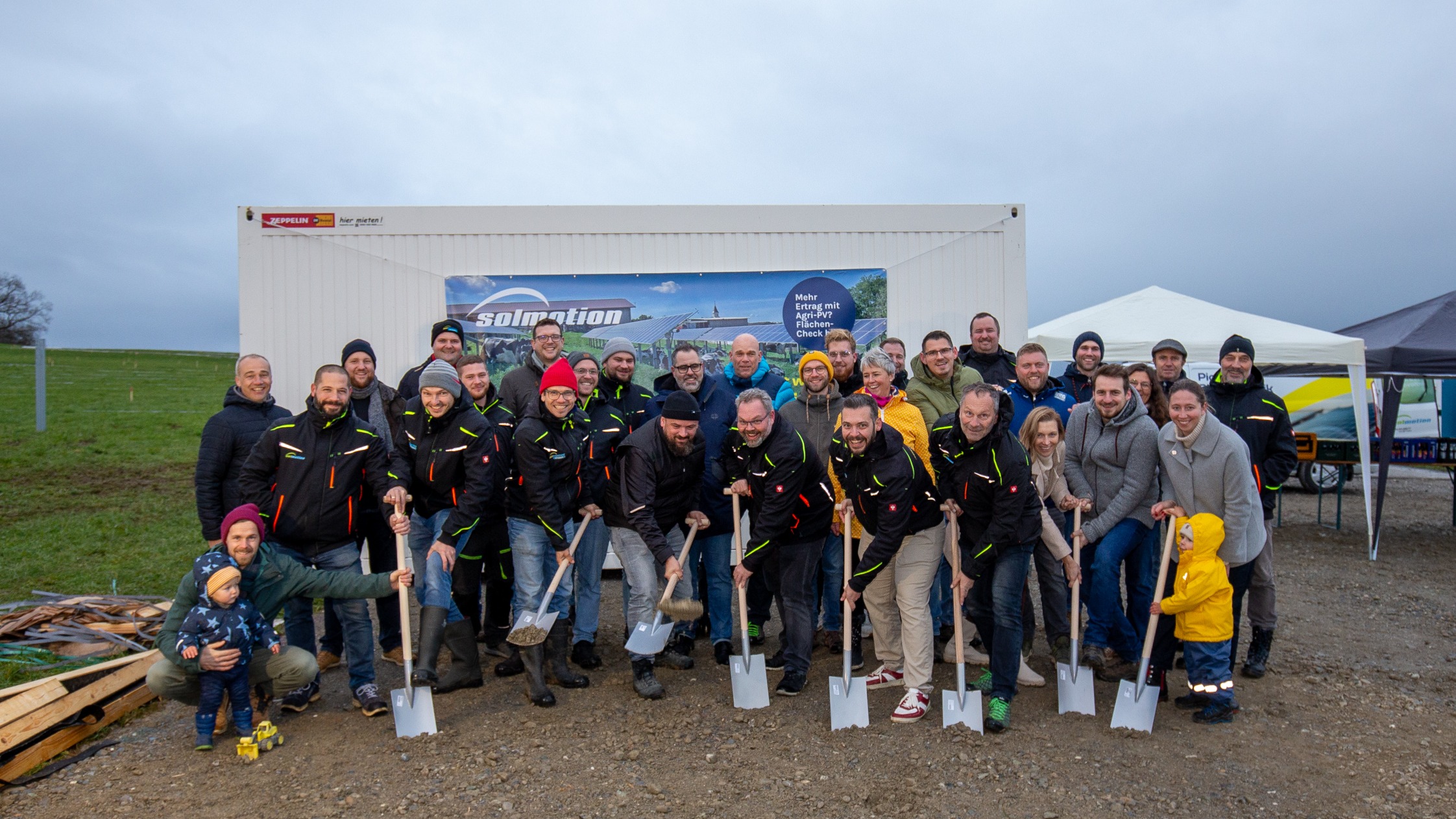
Construction work on three agri-PV systems in southern Germany has now begun. The ground-breaking ceremony took place in November in Bad Waldsee, with the other projects following shortly afterwards. Work is currently underway at all locations. In total, solmotion is implementing an installed capacity of more than 15,000 kWp around Böhringen, Bad Waldsee and Kißlegg.
The factors for success lie in efficient overall planning and implementation from a single source, a sustainable marketing strategy and intelligently controlled and appropriately dimensioned battery storage systems.
All three systems will be built on tracker systems from Zimmermann. The regional manufacturer has continuously developed this technology and now offers one of the most reliable solutions on the market. Particularly powerful bifacial glass-glass modules are used, which also convert reflected light on the rear of the module into electricity. Tracking the modules increases yields, especially when the sun is low in the morning, evening and in winter. Further advantages: snow can be actively shed, and the modules can be flexibly tilted for agricultural work on the land.
In addition, battery storage systems are planned so that the feed-in of the electricity generated can be controlled in line with market conditions throughout the day.
‘At the beginning of last year, like many in the market, we were anxious to see whether the subsidy approval would still come through. It became clear relatively quickly that this decision would not be pushed forward by the new federal government. However, it was equally clear to us that we would not simply write off Agri-PV as a solution for the future,’ explains solmotion Managing Director Michael Keil.
Instead, the company made a conscious decision to rethink its projects. ‘Doing instead of waiting’ was the internal motto. With new strategies and ideas, the team was successful: solmotion is currently developing projects with a total volume of more than 300 MWp – and new ones are being added every day.
External partners also benefit from this expertise: solmotion offers a project check for farmers, investors and project developers. ‘It is often worthwhile taking a second, closer look at projects that are considered uneconomical. With our practical experience and the plants currently under construction, we know how to make the right adjustments,’ says Keil. However, this does not apply to every project: ‘Some would not have been viable even with Solar Package 1 – especially very small plants.’
The ongoing construction of projects in southern Germany is to be followed step by step by further projects. Concrete dates for new projects in 2026 have already been set. Keil: ‘We are convinced that agri-PV will be a real success story – for us and for our partners.’
Project information:
Böhringen:
Total DC project output: 4609.28 kWp
Total number of modules: 7,202, each with 640 Wp
Mounting type: Open space, tracked
Annual feed-in yields: approx. 5,836 MWh
Storage capacity: Still in planning
Bad Waldsee:
Total DC project output: 5,624.32 kWp
Total number of modules: 8,788, each with 640 Wp
Mounting type: Free-standing, tracker-mounted
Annual feed-in yields: approx. 7,643 MWh
Storage capacity: Still in planning
Kißlegg:
Total DC project output: 4,942.08 kWp
Total number of modules: 7,722, each with 640 Wp
Mounting type: free-standing, tracker-guided
Annual feed-in yields: approx. 6,242 MWh
Storage capacity: Still in planning